ABA CPT Codes 2026: The Complete Guide to 97151 – 97158 (With Denial Fixes)
Understand ABA CPT codes 97151–97158 with this complete 2026 guide. Learn what each code covers, who can bill it, documentation requirements, unit rules, and how to prevent common ABA claim denials.
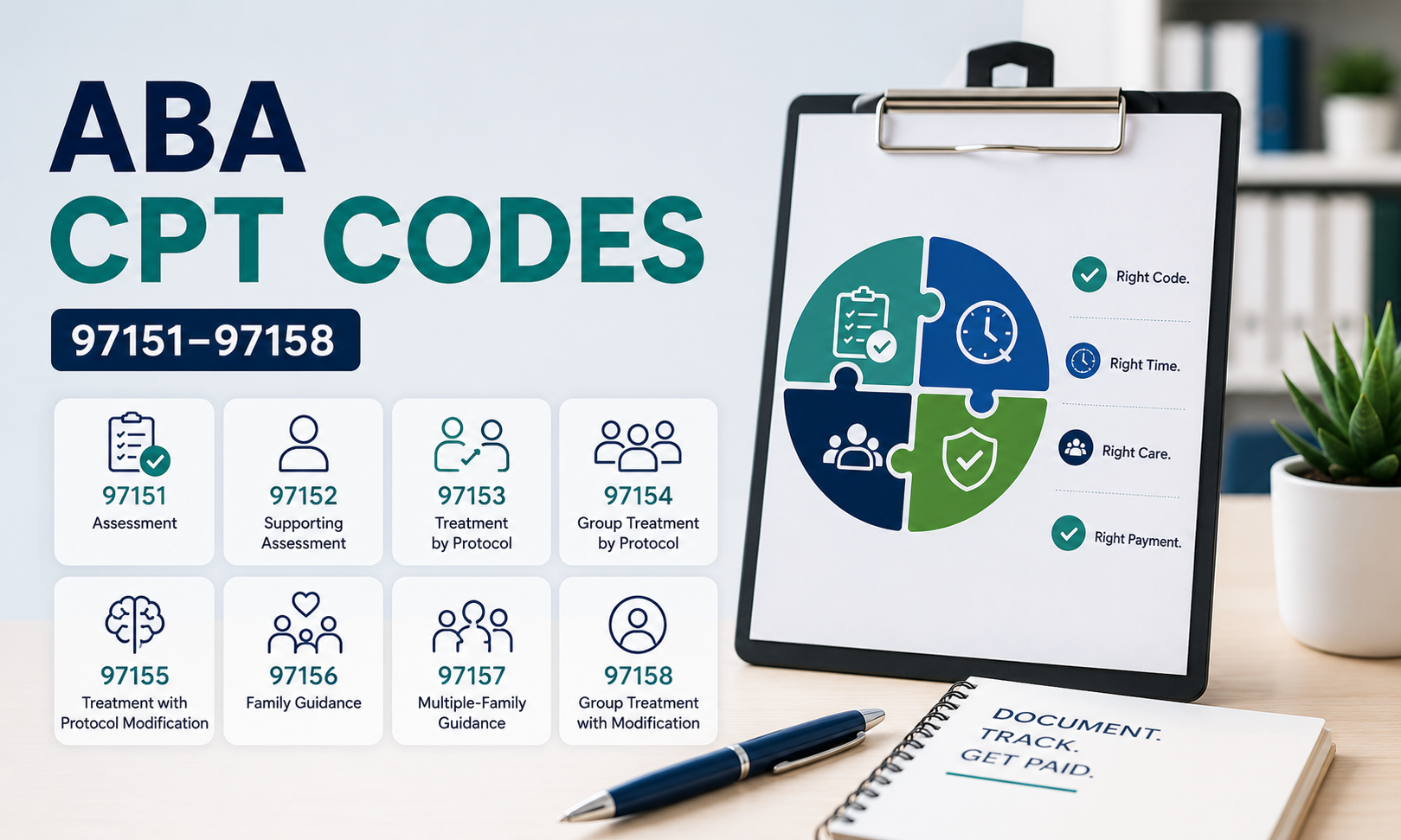
Every claim your ABA practice submits runs on eight Category I CPT codes — 97151 through 97158 — plus a couple of Category III codes for severe-behavior cases. Bill them precisely and cash flow is boring, in the best way. Bill them loosely and you get denials, recoupments, and audit letters.
This guide covers what each code means, who can render it, how units work, what documentation must show, and the specific denial patterns attached to each code — with fixes.
Heads up: the ABA code set is slated for revisions in the 2027 CPT cycle. Bookmark this page — we'll update it when the new descriptors land.
The Code Family at a Glance
| Code | Service | Rendered By | Patient Present? |
|---|---|---|---|
| 97151 | Behavior identification assessment | QHP (BCBA) | Yes (face-to-face portion) |
| 97152 | Behavior identification supporting assessment | Technician, under QHP direction | Yes |
| 97153 | Adaptive behavior treatment by protocol | Technician, under QHP direction | Yes |
| 97154 | Group adaptive behavior treatment by protocol | Technician, under QHP direction | Yes (2+ patients) |
| 97155 | Adaptive behavior treatment with protocol modification | QHP | Yes |
| 97156 | Family adaptive behavior treatment guidance | QHP | Guardian/caregiver present; patient may or may not be |
| 97157 | Multiple-family group adaptive behavior treatment guidance | QHP | Guardians of 2+ patients; patients typically not present |
| 97158 | Group adaptive behavior treatment with protocol modification | QHP | Yes (2+ patients) |
All are 15-minute timed codes. Two Category III codes still matter for severe destructive behavior cases: 0362T (supporting assessment requiring additional staff and environmental customization) and 0373T (treatment with protocol modification under the same intensive conditions). Coverage for the T-codes is far less consistent — verify per payer before relying on them.
Code-by-Code: Rules, Documentation, and Denial Fixes
97151 — Behavior Identification Assessment
The BCBA's assessment code: administering assessments, observing the patient, analyzing results, and developing the treatment plan. Under the code descriptor, the analysis and report-writing components are part of the service — which is why many payers authorize a fixed pool of 97151 units per assessment episode (commonly with annual or six-month reassessment cycles).
Denial patterns & fixes:
- Units exceeded → 97151 pools are small and hard-capped. Track assessment units separately from treatment units in your authorization tracking; request additional units before extending an assessment.
- Frequency denial (reassessment too soon) → payers set minimum intervals; calendar the next eligible reassessment date the day the auth is issued.
- Bundling with same-day treatment → some payers won't pay assessment and treatment codes on the same date. Schedule assessment days as assessment days.
97152 — Supporting Assessment (Technician)
A technician conducts assessment activities (e.g., structured observation, preference assessments) under the BCBA's direction, as part of the 97151 assessment episode. Not all payers cover it separately — some consider it bundled into 97151.
Denial fix: If 97152 denies as bundled, check the payer's policy before appealing; where it's genuinely non-covered, the work belongs inside the 97151 authorization, not on its own claim line.
97153 — Adaptive Behavior Treatment by Protocol
The volume code: 1:1 direct treatment delivered by the RBT/technician following the protocols the BCBA wrote. In most practices this is 70–85% of billed units, which means 97153 hygiene basically is your revenue hygiene.
Documentation must show: date, start/stop times, place of service, rendering technician, protocols targeted, data summary, supervising QHP.
Denial patterns & fixes:
- Units don't match documented time → the auditor's first check. Point-of-care time capture (not end-of-day reconstruction) is the fix; it's also your EVV obligation for home sessions.
- Rendering provider not credentialed/enrolled → RBT roster changes outpace payer enrollment. Gate new technicians' schedules until enrollment confirms.
- Overlap with 97155 → see the concurrent-billing section below and our deep dive: 97153 vs 97155.
97154 — Group Treatment by Protocol
Technician-delivered treatment to two or more patients simultaneously. Bill per patient, but never bill 1:1 code 97153 for group-delivered service — misrepresenting group as individual treatment is a program-integrity issue, not a coding quibble.
Denial fix: Group size limits and coverage vary; several payers restrict 97154/97158 or require the group composition in the note.
97155 — Treatment With Protocol Modification
The BCBA's clinical-decision code: face-to-face treatment during which protocols are assessed and modified, which may include simultaneously directing the technician. The note must read like clinical decision-making — data reviewed, what changed, why — not like a 97153 note with a different code on it.
Denial patterns & fixes:
- Denied as duplicative of 97153 (CO-97) → where the payer allows concurrent delivery, resubmit with distinct provider/time documentation and any required modifier; full walkthrough in our CO-97 guide.
- Audit recoupment for "supervision billed as treatment" → if no protocol was modified, it wasn't 97155. Train BCBAs on the descriptor; audit a sample of notes quarterly.
97156 — Family Guidance (Caregiver Training)
The QHP trains parents/caregivers to implement protocols — with or without the patient present. One of the most telehealth-friendly codes in the family (modifier and POS rules here).
Denial fixes: Identify the patient (not the parent) as the member on the claim; document who attended and which protocols were trained; watch per-week unit limits some payers impose.
97157 — Multiple-Family Group Guidance
Group caregiver training across families, without patients present. Bill per patient/family per the payer's convention.
97158 — Group Treatment With Protocol Modification
QHP-delivered group treatment where protocols are adjusted — think social-skills groups run by the BCBA. Same group-documentation discipline as 97154.
Concurrent and Same-Day Billing: The Rules That Prevent CO-97
The combinations that generate the most confusion:
- 97153 + 97155 same time block: widely (not universally) payable when the technician delivers treatment while the BCBA directs and modifies — two providers, two services. Distinct notes, matching times, correct rendering providers. Where the overlap isn't covered, only one provider's time is billable.
- 97153 + 97156 same time block: commonly payable when the technician treats the child while the QHP trains the caregiver in another room — again, different providers, documented separately.
- Two technicians, one patient: generally not separately billable under the core codes (that's what 0362T/0373T address in severe cases).
- ABA + another discipline (OT/speech) same day: payable with distinct times and providers; overlapping times are where multidisciplinary practices bleed — full treatment in our multidisciplinary billing pillar.
The Five Habits of Clean ABA Billing
- Track authorized units per code, live, at scheduling — not in a spreadsheet after the fact.
- Capture times at the point of care so notes, EVV, and claims agree to the minute.
- Keep a payer grid for concurrent-billing rules, telehealth coverage by code, and unit-rounding conventions.
- Match rendering providers to enrollment status before sessions happen.
- Scrub every claim for code conflicts, modifier needs, and auth mismatches before submission.
TherapyPM does all five in one system — see how it works for ABA practices — and the TherapyPM RCM team lives in these codes daily if you'd rather hand the whole revenue cycle off.
Frequently Asked Questions
Are ABA Codes Timed or Untimed?
All of 97151–97158 are 15-minute timed codes; rounding conventions vary by payer.
Can 97151 Be Done via Telehealth?
Portions often can (interviews, records review, caregiver components); direct observation requirements vary by payer.
What Changed in the Codes Recently — and What's Coming?
The current descriptors have been stable since the 2019 Category I conversion; a revision cycle is expected for 2027. We'll update this guide when final descriptors publish.
Ready to simplify your therapy practice?
Join 500+ clinics already using TherapyPM to streamline billing, documentation, credentialing, and more.
More in ABA
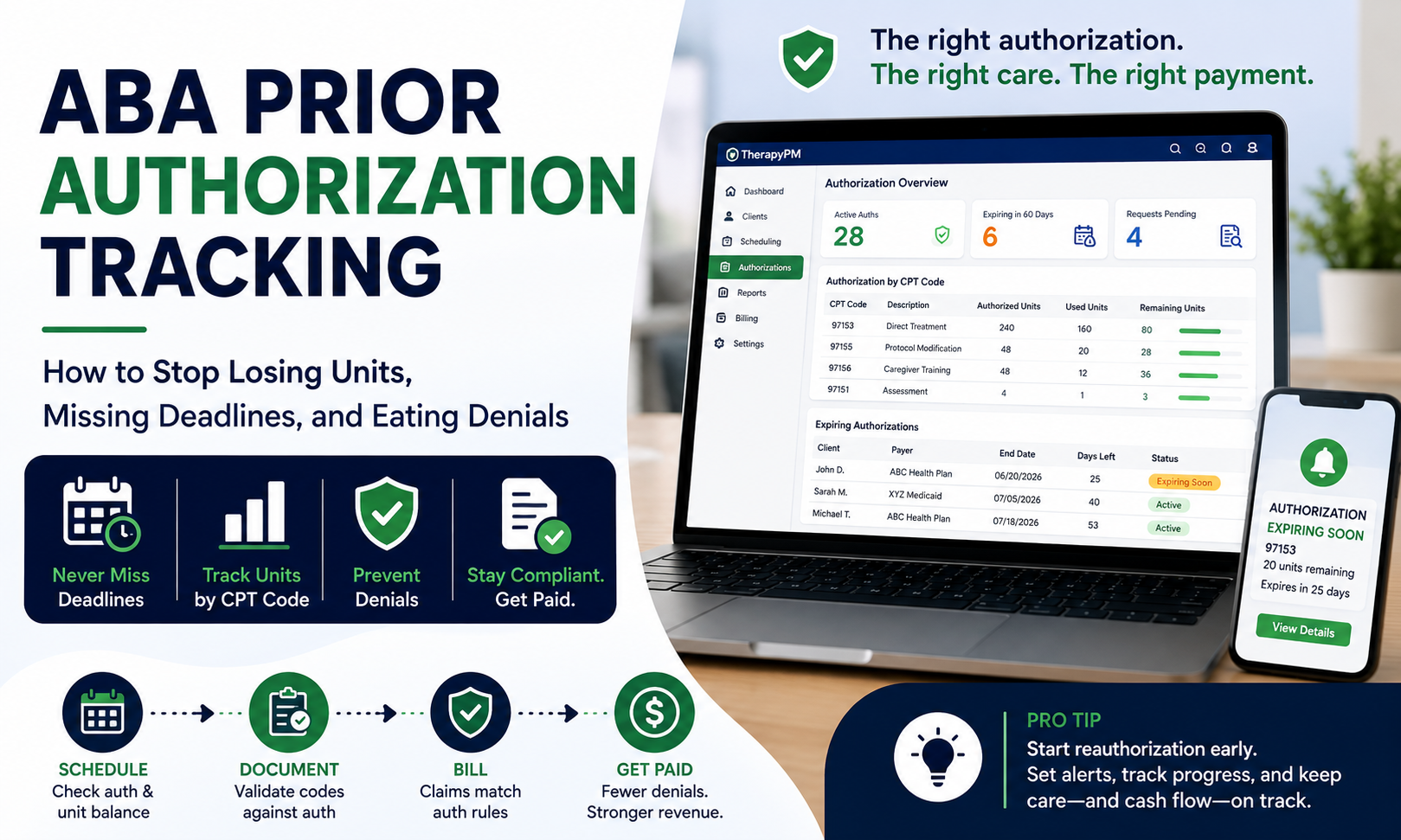
ABA Prior Authorization Tracking: How to Stop Losing Units, Missing Deadlines, and Eating Denials
Aug 4, 2026
5 min read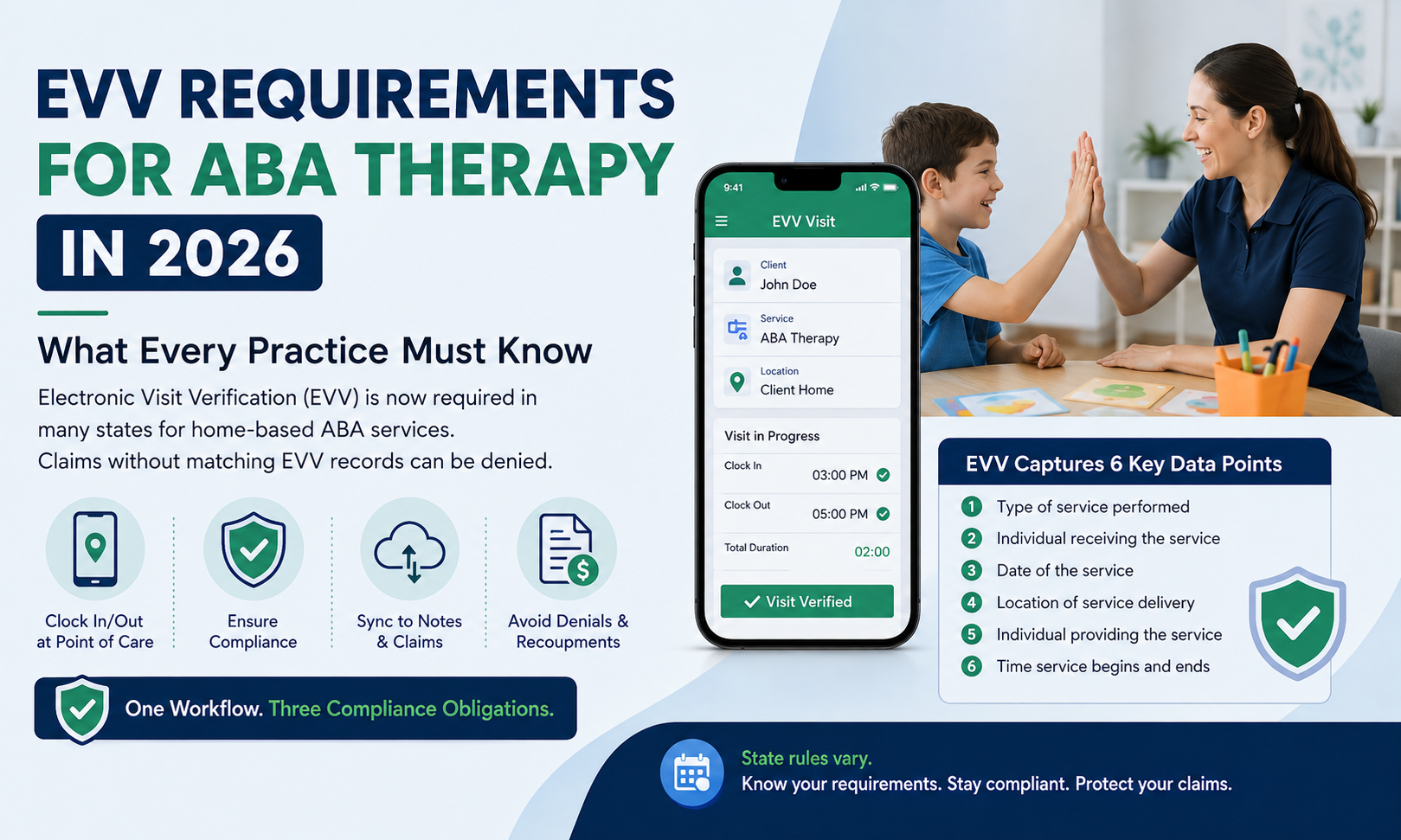
EVV Requirements for ABA Therapy in 2026: What Every Practice Must Know
Aug 4, 2026
6 min read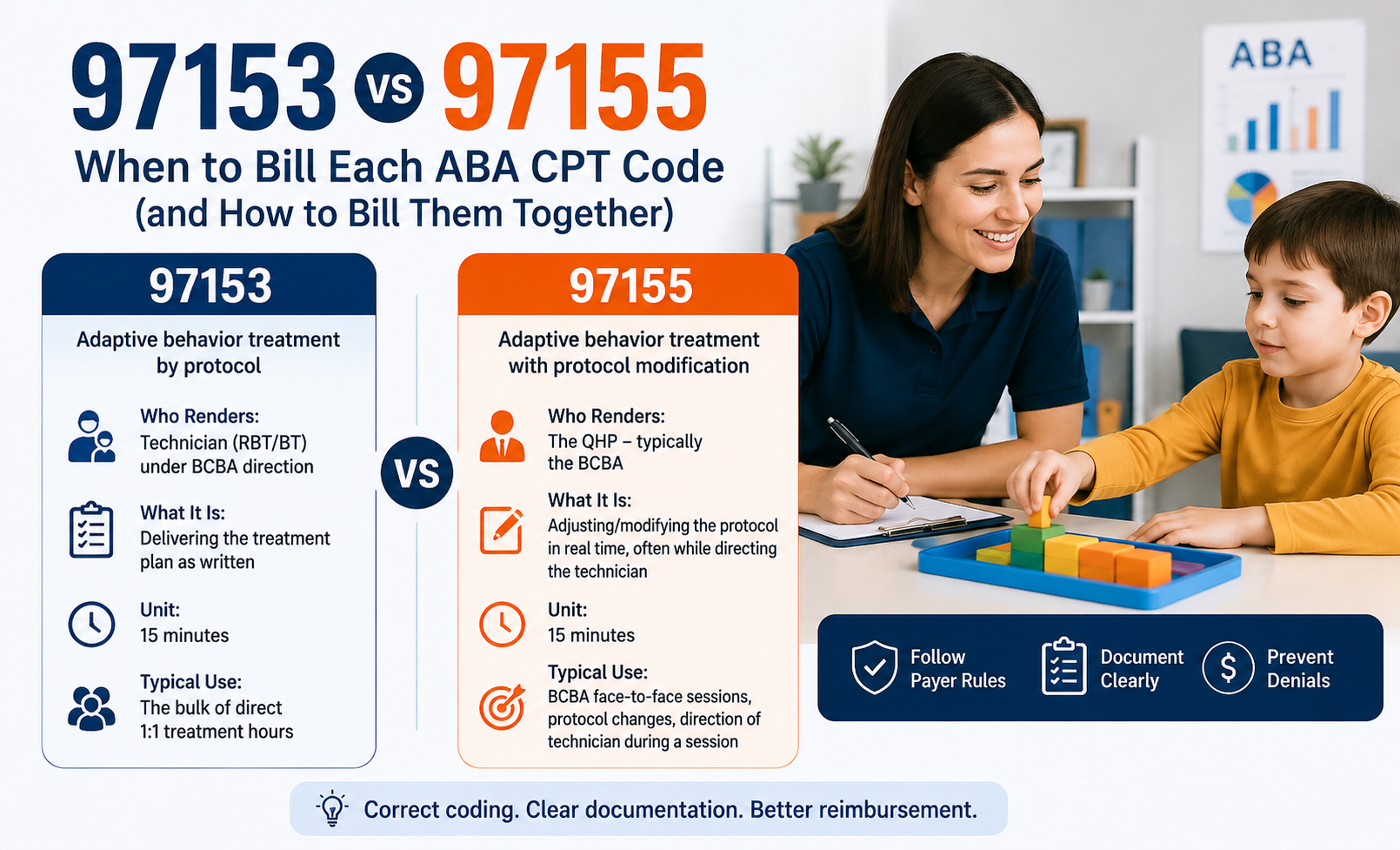
97153 vs 97155: When to Bill Each ABA CPT Code (and How to Bill Them Together)
Aug 4, 2026
5 min read