97153 vs 97155: When to Bill Each ABA CPT Code (and How to Bill Them Together)
Understand the key differences between ABA CPT codes 97153 and 97155, who can bill each code, concurrent billing rules, documentation requirements, and how to avoid common claim denials.
Two codes carry most of the revenue in a typical ABA practice — and they're also the two most often confused, mis-billed, and denied. Here's the practical difference between 97153 and 97155, who bills each, and how to handle the tricky scenarios: concurrent sessions, supervision time, and same-day billing.
The short answer
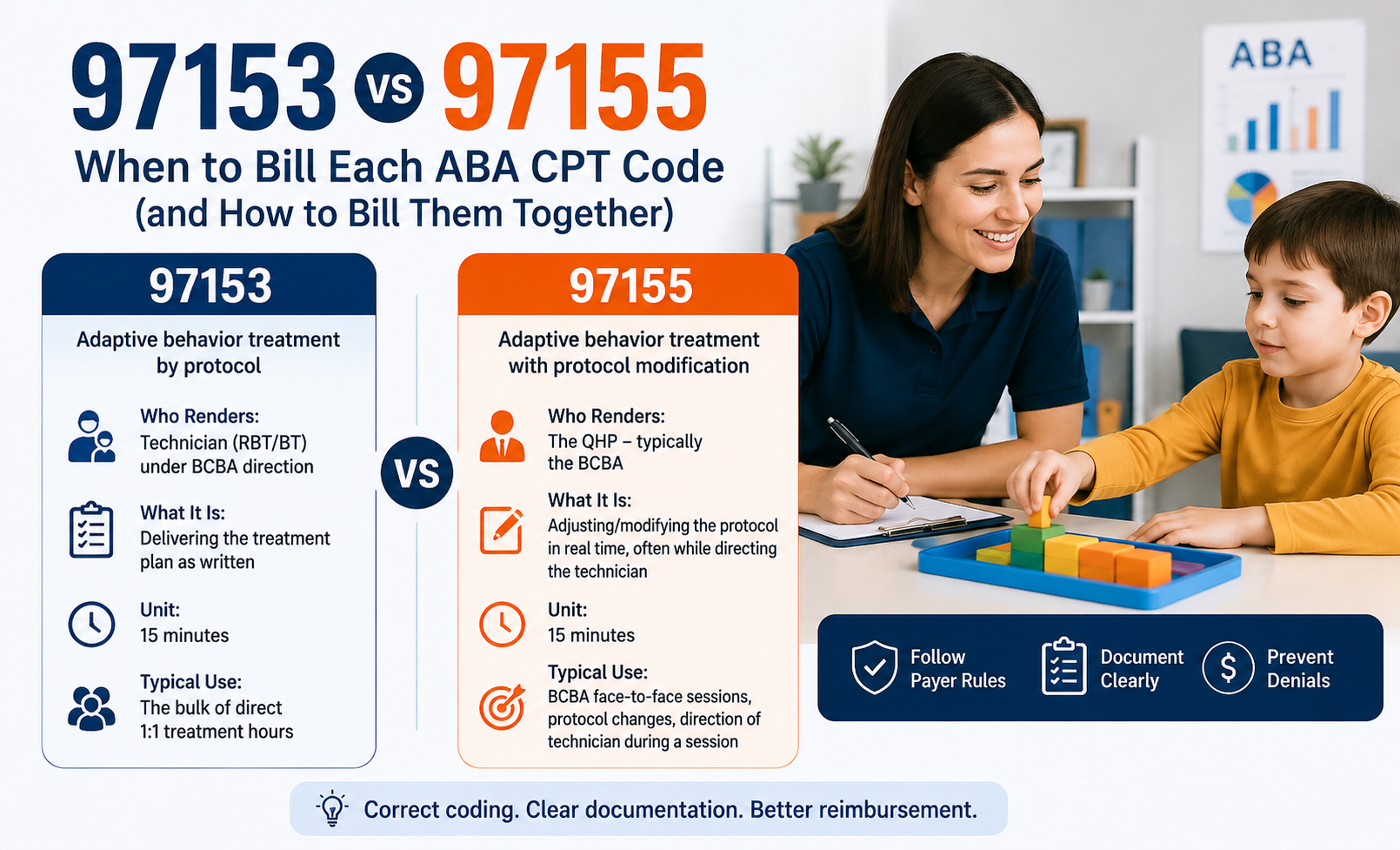
| 97153 | 97155 | |
|---|---|---|
| What it is | Adaptive behavior treatment by protocol | Adaptive behavior treatment with protocol modification |
| Who renders it | Technician (RBT/BT) under BCBA direction | The QHP — typically the BCBA |
| What's happening | Delivering the treatment plan as written | Adjusting/modifying the protocol in real time, often while directing the technician |
| Unit | 15 minutes | 15 minutes |
| Typical use | The bulk of direct 1:1 treatment hours | BCBA face-to-face sessions; protocol changes; direction of technician during a session |
The distinction payers care about: 97153 is executing the plan; 97155 is changing the plan. If the BCBA is face-to-face with the client actively modifying protocols — or directing the technician while modifying protocols — that's 97155. If a technician is running programs as written, that's 97153.
Where practices get it wrong
Mistake 1 — Billing 97155 for pure supervision. Watching a technician run programs and giving general feedback isn't automatically 97155. The code requires the QHP to be delivering treatment with protocol modification. If no protocols are being assessed and adjusted, payers can recoup it on audit. Document what was modified and why.
Mistake 2 — Billing 97153 for the technician while the BCBA bills 97155 — without checking the payer's concurrent-billing rule. Many payers do allow 97155 (BCBA, directing and modifying) and 97153 (technician, delivering) during the same time block, precisely because two different providers are rendering two different services. Others restrict or forbid the overlap. This is contract-specific: build a payer grid and make it visible to your billers. When overlap is allowed, both notes must show distinct roles and matching times; when it isn't, the technician's overlapping time is typically not separately billable.
Mistake 3 — Unit-rounding errors. Both codes bill in 15-minute units. Most ABA payers follow a midpoint convention (a unit is billable once you pass the halfway point), but conventions differ by payer and state Medicaid program. Session start/stop times in the note must support the units on the claim — this is the first thing auditors check.
Mistake 4 — Same-day 97153 + 97155 without modifiers where required. Same-day combinations can trigger bundling edits (hello, CO-97 denials). Some payers want a modifier on one line; some want distinct time blocks visible; some want both.
Documentation that survives an audit
For 97153, each session note should show: date, start/stop time, place of service, rendering technician, protocols run, data collected, and the supervising BCBA.
For 97155, the note must additionally show the clinical decision-making: what data prompted the modification, what was changed in the protocol, and the plan going forward. A 97155 note that reads like a 97153 note is an audit finding waiting to happen.
This is where software design matters. When your data collection, session notes, and billing live in one system, the note's start/stop times and rendering provider flow directly onto the claim — no transcription, no mismatches. That's exactly how TherapyPM's ABA documentation is built.
Quick scenarios
Technician runs a 2-hour session, BCBA drops in for 30 minutes to adjust a protocol.
Technician: 8 units of 97153. BCBA: 2 units of 97155 — if the payer allows the overlap; otherwise structure the visit so the segments don't overlap, or bill per the contract's direction rules.
BCBA runs a solo session with the client, modifying protocols throughout.
97155 for the BCBA's face-to-face time. No 97153 — no technician rendered service.
BCBA reviews data and updates programs at the office, client not present.
Generally neither code — both require the patient present under most payer policies. Non-face-to-face plan work is usually bundled into 97151 (assessment/plan) or non-billable, depending on the payer.
FAQ
Can 97155 be delivered via telehealth?
Many payers allow it with the right modifier and place-of-service code — see our 2026 telehealth modifier guide.
Is there a cap on 97155 hours?
Caps come from the authorization, not the code. Track authorized units by code so you never bill past them — auth-tracking is one of the highest-impact things your practice can automate (here's how).
Who can render 97153?
A behavior technician working under the direction of the QHP; credential requirements (RBT certification, state registration) vary by payer and state.
Bill both codes cleanly, every time
TherapyPM tracks authorized units by CPT code, matches rendering providers to sessions, carries documented start/stop times onto claims, and scrubs same-day code conflicts before submission. And when payer rules get murky, the TherapyPM RCM team — who work ABA claims all day — can audit your 97153/97155 billing patterns and fix what's leaking.
See TherapyPM for ABA practices or talk to the RCM team.
Ready to simplify your therapy practice?
Join 500+ clinics already using TherapyPM to streamline billing, documentation, credentialing, and more.
More in ABA

ABA CPT Codes 2026: The Complete Guide to 97151 – 97158 (With Denial Fixes)
Aug 4, 2026
8 min read
ABA Prior Authorization Tracking: How to Stop Losing Units, Missing Deadlines, and Eating Denials
Aug 4, 2026
5 min read
EVV Requirements for ABA Therapy in 2026: What Every Practice Must Know
Aug 4, 2026
6 min read