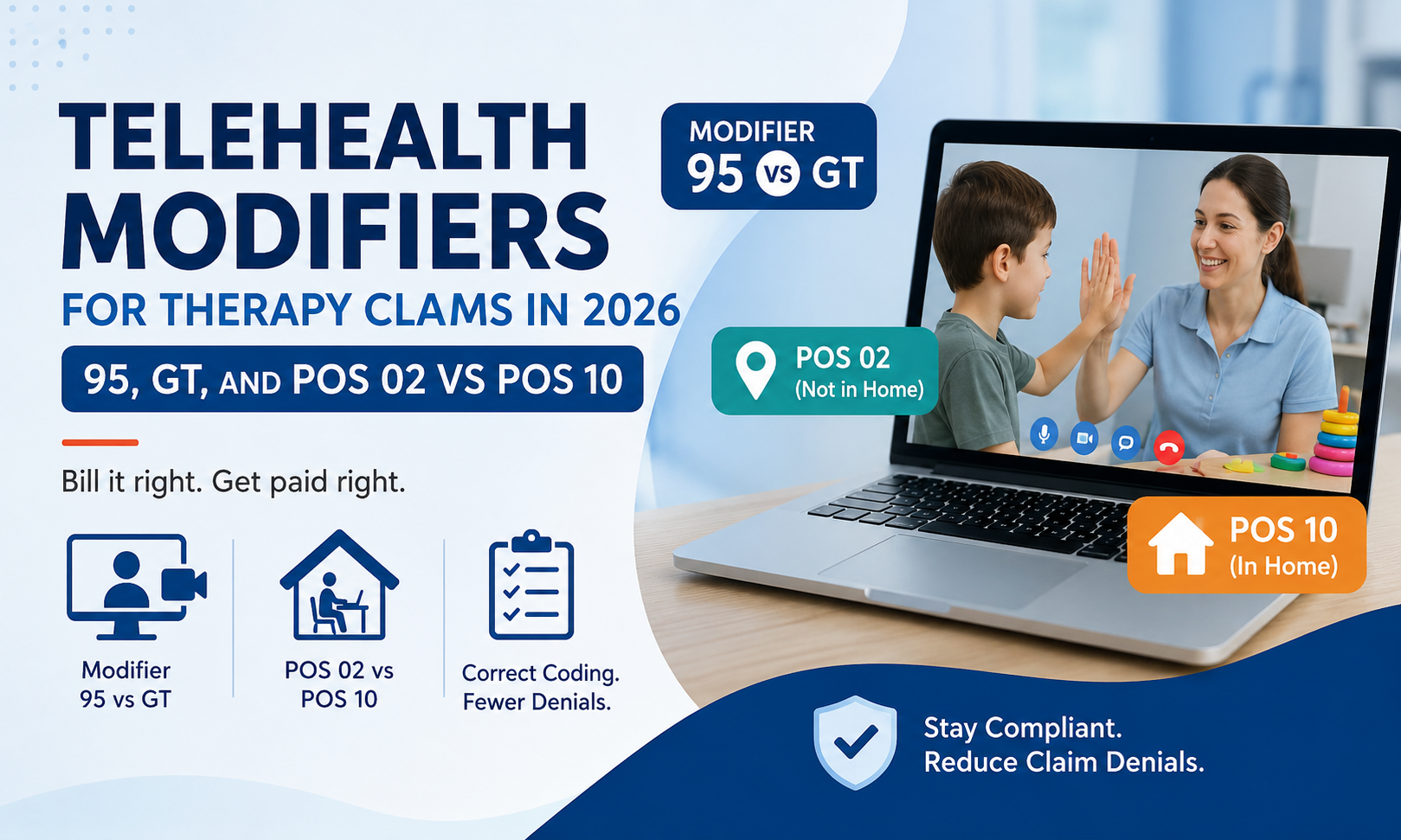
Telehealth Modifiers for Therapy Claims in 2026: 95, GT, and POS 02 vs POS 10
Confused about modifier 95 vs GT or POS 02 vs POS 10? Learn how to correctly bill telehealth claims for ABA, speech, OT, and PT services in 2026 and reduce avoidable claim denials.
Telehealth kept many therapy practices alive in 2020 — and has confused their billers ever since. Rules that changed during the public health emergency changed again after it, and payers didn't all land in the same place. The result: perfectly good telehealth sessions denied over a two-character modifier or the wrong place-of-service code.
Here's what each element means, and a clean decision process for ABA, speech, OT, and PT claims in 2026.
The Three Moving Parts of a Telehealth Claim
Every telehealth claim communicates three things:
- The service — the CPT code (97153, 92507, 97110, 90834…), same as in-person.
- How it was delivered — the modifier (95, GT, sometimes FQ/93 for audio-only where permitted).
- Where the patient was — the place-of-service (POS) code.
Denials happen when these three don't tell a consistent story the payer's system accepts.
Modifier 95 vs GT: Which One?
Modifier 95 — synchronous telemedicine service via real-time interactive audio and video. This is the default for most commercial payers today and the one to reach for first.
Modifier GT — the older "via interactive audio and video" modifier. Medicare stopped requiring GT on professional claims years ago (POS coding took over that job), but some Medicaid programs and legacy commercial contracts still require GT instead of — or alongside — 95.
Practical rule: default to 95; use GT only where a specific payer contract or state Medicaid manual says so. Never guess — a payer grid beats memory.
Audio-only: where a payer permits audio-only delivery for a given service, a separate indicator (such as modifier 93, or FQ for some behavioral-health contexts) is typically required. Many therapy services are not payable audio-only — verify per payer before offering it.
POS 02 vs POS 10: The One Everyone Gets Wrong
Since 2022 there have been two telehealth place-of-service codes:
- POS 02 — telehealth provided other than in the patient's home (e.g., patient at a clinic, school, or facility connecting remotely).
- POS 10 — telehealth provided in the patient's home.
Most pediatric therapy telehealth happens with the child at home — which means POS 10 is usually correct, yet claims systems and old habits keep defaulting to POS 02. Some payers pay different rates by POS (home vs facility-based telehealth), so this isn't cosmetic.
Watch for: a handful of payers instruct providers to bill telehealth with the in-person POS (e.g., 11) plus modifier 95, so the claim prices at the non-facility rate. This is exactly the kind of contract-level quirk that belongs in your payer grid, not in a biller's head.
Discipline-Specific Notes
ABA (97151–97158): Telehealth coverage for ABA codes is payer-by-payer. Protocol modification and caregiver training (97155, 97156) are the most widely accepted via telehealth; direct technician-delivered treatment (97153) via telehealth is far less consistently covered. Confirm code-by-code, and pair the modifier with the right POS. (Refresher on the codes themselves: 97153 vs 97155.)
Speech therapy (92507, 92523): Broadly telehealth-friendly with commercial payers and many Medicaid programs; 95 + POS 10 is the common pattern for at-home sessions.
OT/PT (97110, 97530, evals): Coverage expanded significantly and Medicare's telehealth allowances for therapy services have been repeatedly extended by legislation — but extensions come with end dates. Check the current status each January and each time Congress passes a health extender package, and verify commercial payers separately; many follow Medicare's lead loosely, not exactly.
A 5-Step Decision Checklist for Every Telehealth Claim
- Is this CPT code payable via telehealth under this payer's current policy? If not, stop — no modifier fixes non-coverage.
- Was it real-time audio+video? If audio-only, is that permitted for this code and payer, and which indicator do they require?
- Where was the patient? Home → POS 10. Anywhere else → POS 02 (unless the contract dictates the in-person POS + modifier pattern).
- Which modifier does this payer require? 95 by default; GT (or others) only where specified.
- Does the documentation state the delivery method and both locations (provider site and patient site)? Auditors ask.
FAQ
Do I need consent documentation for telehealth?
Most states and many payers require documented patient/guardian consent for telehealth — capture it once in intake and reference it in notes.
Can modifiers 95 and GT go on the same claim line?
A few payers ask for exactly that; most want one. Payer grid, again.
Does POS 10 change reimbursement?
It can — some payers pay home-based telehealth at parity with in-person, others don't. Model it per contract before shifting service mix.
Make Telehealth Claims Boring Again
TherapyPM's telehealth sessions flow straight into documentation and billing, with payer-specific modifier and POS rules applied automatically at claim creation — so 95 vs GT and 02 vs 10 stop being things your billers memorize. Already sitting on telehealth denials? The TherapyPM RCM team can rework and resubmit them with the correct modifier/POS combinations.
Explore TherapyPM Telehealth· Talk to the RCM team
Ready to simplify your therapy practice?
Join 500+ clinics already using TherapyPM to streamline billing, documentation, credentialing, and more.
More in Billing
CO-97 Denial Code in Therapy Billing: What It Means and How to Fix It
Aug 4, 2026
5 min read
Tired of Claim Denials? Here’s a Modern Guide for Eligibility and Benefits Verification!
Aug 19, 2025
10 min read
One Platform, Total Control – Avoid Payment Delays with TherapyPM!
Jul 8, 2025
9 min read