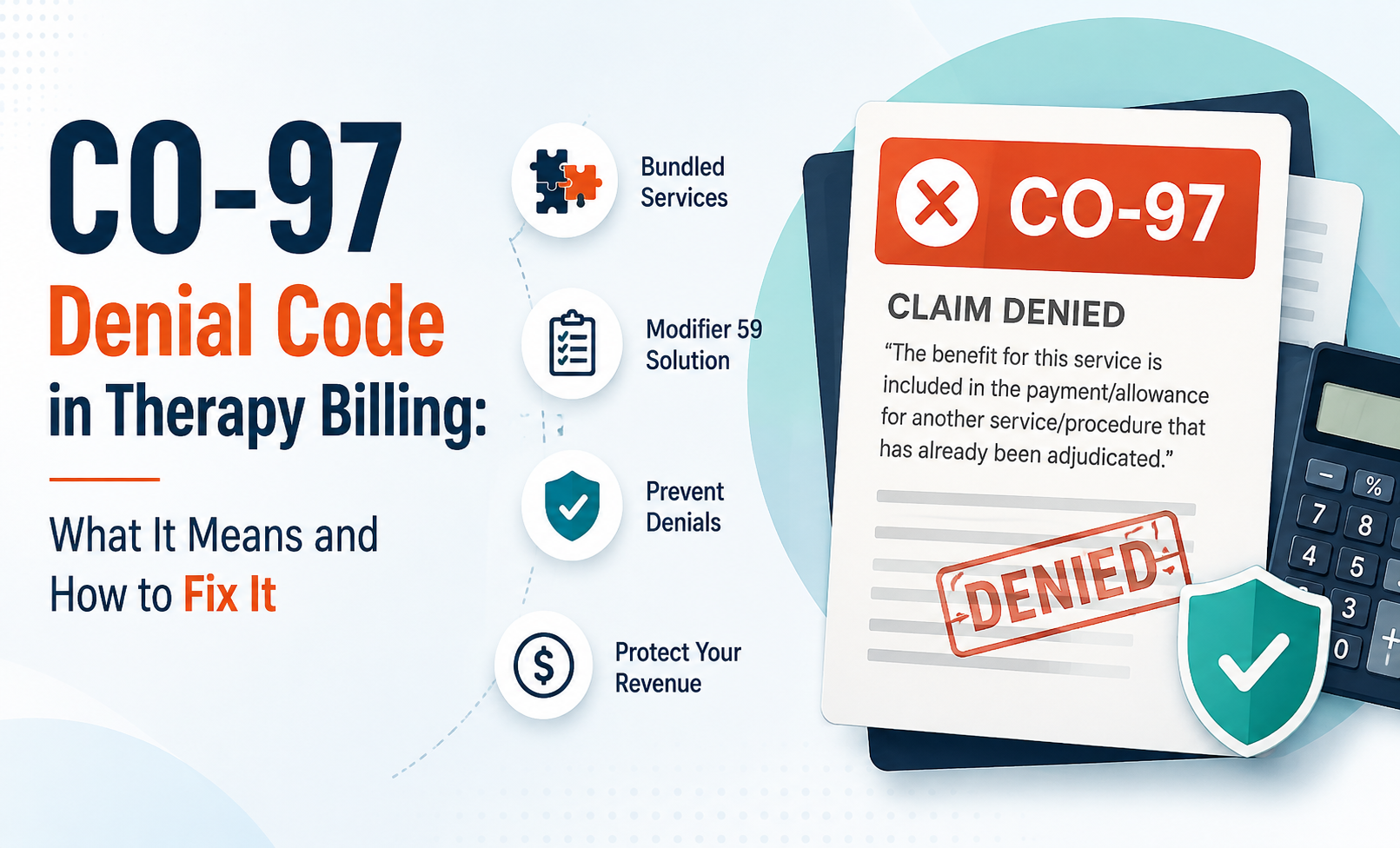
CO-97 Denial Code in Therapy Billing: What It Means and How to Fix It
Learn what causes CO-97 denials in therapy billing, how Modifier 59 can help correct bundled-service denials, and how to prevent them before claims are submitted.
If you run an ABA, speech, occupational, or physical therapy practice, you've almost certainly seen this remark on a remittance: CO-97 — "The benefit for this service is included in the payment/allowance for another service/procedure that has already been adjudicated."
In plain English: the payer thinks the service you billed is bundled into another service you billed for the same patient on the same day — so they paid one and denied the other.
CO-97 denials are frustrating because the therapy was delivered, documented, and medically necessary. The problem is almost never the care. It's how the claim communicated (or failed to communicate) that two services were separate and distinct.
Why therapy practices get CO-97 denials
The most common triggers we see across ABA and multidisciplinary claims:
1. Two services billed the same day without a distinguishing modifier. Payers run claims through National Correct Coding Initiative (NCCI) edits. When two codes appear in an edit pair — say, a therapeutic procedure and a related service on the same date — the payer bundles them by default unless a modifier tells them not to.
2. Overlapping session times. If an ABA direct-treatment session (97153) and a protocol-modification session (97155) — or an ABA session and an OT session — appear to overlap in time, many payers treat one as included in the other. Concurrent billing is allowed in specific scenarios, but only when rendered by different qualified providers and documented with distinct start/stop times.
3. Missing or wrong rendering-provider details. When two disciplines treat the same child on the same day but the claim doesn't clearly show different rendering providers, bundling logic kicks in.
4. Re-evaluations billed alongside treatment. Billing an assessment or re-assessment code on the same day as treatment frequently triggers bundling edits unless the documentation and coding justify both.
The fix: Modifier 59 (and its X-modifier cousins)
Modifier 59 signals a "distinct procedural service" — telling the payer that two services normally bundled together were genuinely separate on this occasion (different session, different time block, different provider, or different site of service).
Some payers (including Medicare for rehab therapy) prefer the more specific X-modifiers:
- XE — separate encounter
- XS — separate structure/site
- XP — separate practitioner
- XU — unusual non-overlapping service
How to correct a CO-97 denial, step by step:
- Pull the EOB/ERA and identify the code pair. Which service was paid, and which was bundled into it?
- Check the NCCI edit pair status. If the modifier indicator allows a bypass (indicator "1"), a modifier can unbundle it. If it's indicator "0," no modifier will help — the denial stands and the fix is coding differently next time.
- Verify your documentation supports "distinct." Separate session notes, distinct start/stop times, and different rendering providers must be visible in the record before you appeal.
- Resubmit as a corrected claim with modifier 59 (or the payer-preferred X-modifier) on the appropriate line — usually the column-two (bundled) code, not both.
- Appeal with documentation if the corrected claim is denied again: attach both session notes showing times and providers.
⚠️ What not to do: never append modifier 59 routinely to every same-day claim "just in case." Payers audit modifier 59 usage aggressively, and a pattern of reflexive 59s is one of the fastest ways to land on a payer's audit list.
Preventing CO-97 before the claim goes out
Fixing denials one at a time is a treadmill. The durable fix is catching bundling conflicts before submission:
- Scrub claims against NCCI edit pairs automatically. TherapyPM's claim scrubbing flags same-day code conflicts and missing modifiers before the claim leaves your system.
- Capture start/stop times at the point of care. If session times live in your documentation platform and flow onto the claim, overlap disputes become winnable.
- Map rendering providers correctly for every discipline in multidisciplinary practices, so concurrent ABA + speech + OT services adjudicate as distinct.
- Track your denial reasons by code. If CO-97 is more than a small share of your denials, you have a systematic coding-workflow problem, not bad luck.
FAQ
Is CO-97 the same as a duplicate-claim denial?
No. Duplicates typically come back as CO-18. CO-97 means the payer paid a different service and considers yours included in it.
Can I bill 97153 and 97155 on the same day?
Yes — in many payer policies 97155 (protocol modification by the BCBA) can even run concurrently with 97153 (direct treatment by the RBT) when both providers are present and times are documented. Payer rules vary, so confirm each contract. (We cover this in detail in our 97153 vs 97155 guide.)
Does modifier 59 guarantee payment?
No. It only works when the NCCI edit allows a modifier bypass and your documentation supports two distinct services.
Stop losing revenue to preventable denials
Every CO-97 you rework costs staff time; every one you miss is delivered care you never get paid for. TherapyPM's built-in claim scrubbing catches bundling conflicts, missing modifiers, and same-day code clashes before submission — and if denials have already piled up, the TherapyPM RCM team can work your aging report, file corrected claims, and appeal what's recoverable.
Book a demo or talk to our RCM team about a denial-recovery review.
Ready to simplify your therapy practice?
Join 500+ clinics already using TherapyPM to streamline billing, documentation, credentialing, and more.
More in Billing

Telehealth Modifiers for Therapy Claims in 2026: 95, GT, and POS 02 vs POS 10
Aug 4, 2026
5 min read
Tired of Claim Denials? Here’s a Modern Guide for Eligibility and Benefits Verification!
Aug 19, 2025
10 min read
One Platform, Total Control – Avoid Payment Delays with TherapyPM!
Jul 8, 2025
9 min read